


Solar
We have team of engineers & technical staff for erecting and commissioning of solar projects ,roof top as well as solar-power-plants setups.
Electrical
Our company deal in all type of electrical projects related to electrification and electrical n/w.we have teams of engineers and related staff for construction of LT & HT lines and substations.
Grid Connected Solar System
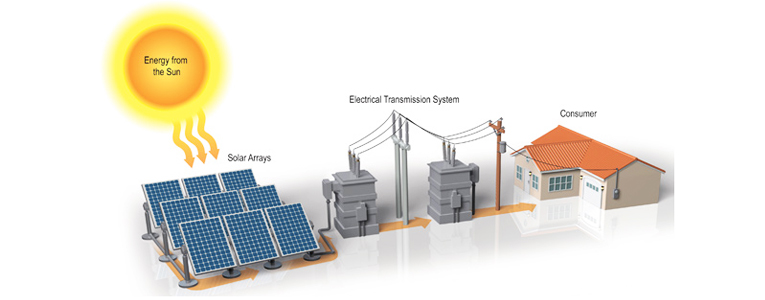
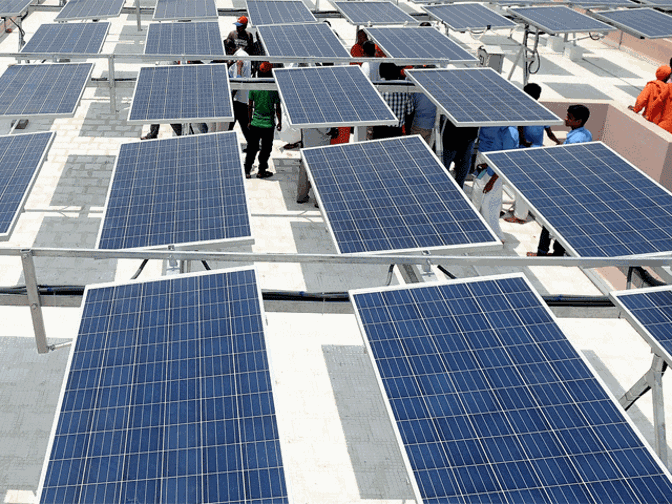
Solar panels that harness the sun's power to generate electricity provide clean power for homes, communities and businesses, and help cut global carbon emissions. Solar photovoltaic (pv) modules generate electricity from sunlight, which can be fed into the mains electricity supply of a building or sold to the public electricity grid. Reducing the need for fossil fuel generation, the growing grid-connected solar PV sector across the globe is helping create jobs, enabling families and businesses to save money, and cut greenhouse emissions.
Solar Thermal
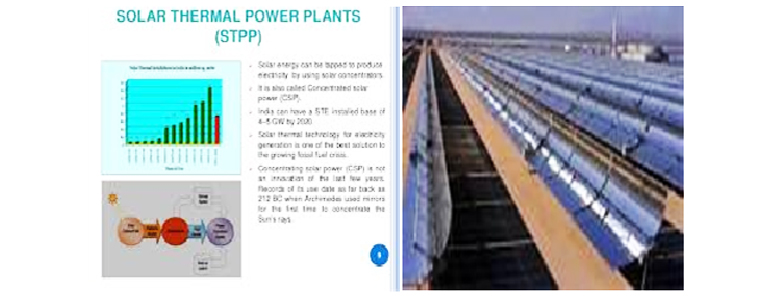
Solar heat has been used for millennia for drying crops and clothes. With a bit of technology, a lot more can be done: providing hot water for washing, improving comfort or generating electricity.

How Grid Connected Pv Systems Works
PV modules use semiconductor materials to generate dc electricity from sunlight. A large area is needed to collect as much sunlight as possible, so the semiconductor is either made into thin, flat, crystalline cells, or deposited as a very thin continuous layer onto a support material. The cells are wired together and sealed into a weatherproof module, with electrical connectors added. Modern modules for grid connection usually have between 48 and 72 cells and produce dc voltages of typically 25 to 40 volts, with a rated output (see box) of between 150 and 250 Wp. In order to supply electricity into a mains electricity system, the dc output from the module must be converted to ac at the correct voltage and frequency. An electronic inverter is used to do this. Generally a number of PV modules are connected in series to provide a higher dc voltage to the inverter input, and sometimes several of these ‘series strings’ are connected in parallel, so that a single inverter can be used for 50 or more modules. Modern inverters are very efficient (typically 97%), and use electronic control systems to ensure that the PV array keeps working at its optimum voltage. They also incorporate safety systems as required in the country of use Many grid connected PV systems are installed on frames which are mounted on the roof or walls of a building. Used in this way the PV does not take up land that could be used for other purposes. Ideally the PV faces towards the equator (i.e. South in the northern hemisphere) but the exact direction is not critical. However, it is important to make sure that there is minimal shading of the PV. The inverter is housed inside the building and connected to the mains electrical supply, usually with a meter to measure the kWh generated. If the PV electricity production exceeds building demand then the excess can be exported to the grid, and vice versa. 1 kWp PV systems installed on bungalows in Huddersfield, UK. A grid connected system rated at 1 kWp (1000 Wp) has an area of between 5 and 14 m2, depending on the type of semiconductor. The photo shows 1 kWp systems using crystalline PV modules, installed by Ashden Award-winner Kirklees Council. If the PV system is installed during construction or refurbishment, it can sometimes be used as part of the building fabric, such as a roof or wall-cladding. Ashden Award winner Solarcentury has integrated PV arrays into a wide range of buildings. Where space and sun are available, large stand-alone PV arrays can be built and connected to the public grid. In 2010, the largest operating system is a 55 MWp ‘photovoltaic park’ in Olmedilla, Spain, but plants of up to 550 MWp capacity are being planned. Grid-connected systems do not usually include batteries for storage, because the mains grid can accept or provide power as needed. However, if rechargeable batteries are included, a grid-connected PV system can be used as a standalone ac supply in the event of a power cut, to allow essential loads to keep working. Ashden winner Deng solar provided a 9.2 kWp grid backup system for the central courts in Accra, Ghana, which maintains lighting and thus enables court business to keep going during power cuts. The Aryavart Gramin Bank has provided PV grid backup systems for its rural branches, so that their IT systems and cash machines still work during power cuts and voltage fluctuations.

